
What Lazy Bear has said about the workforce
These are the statements that come from the developer’s own store copy and devlogs rather than from pre-release play, so they are the safest layer of this page.
Machines, not just benches
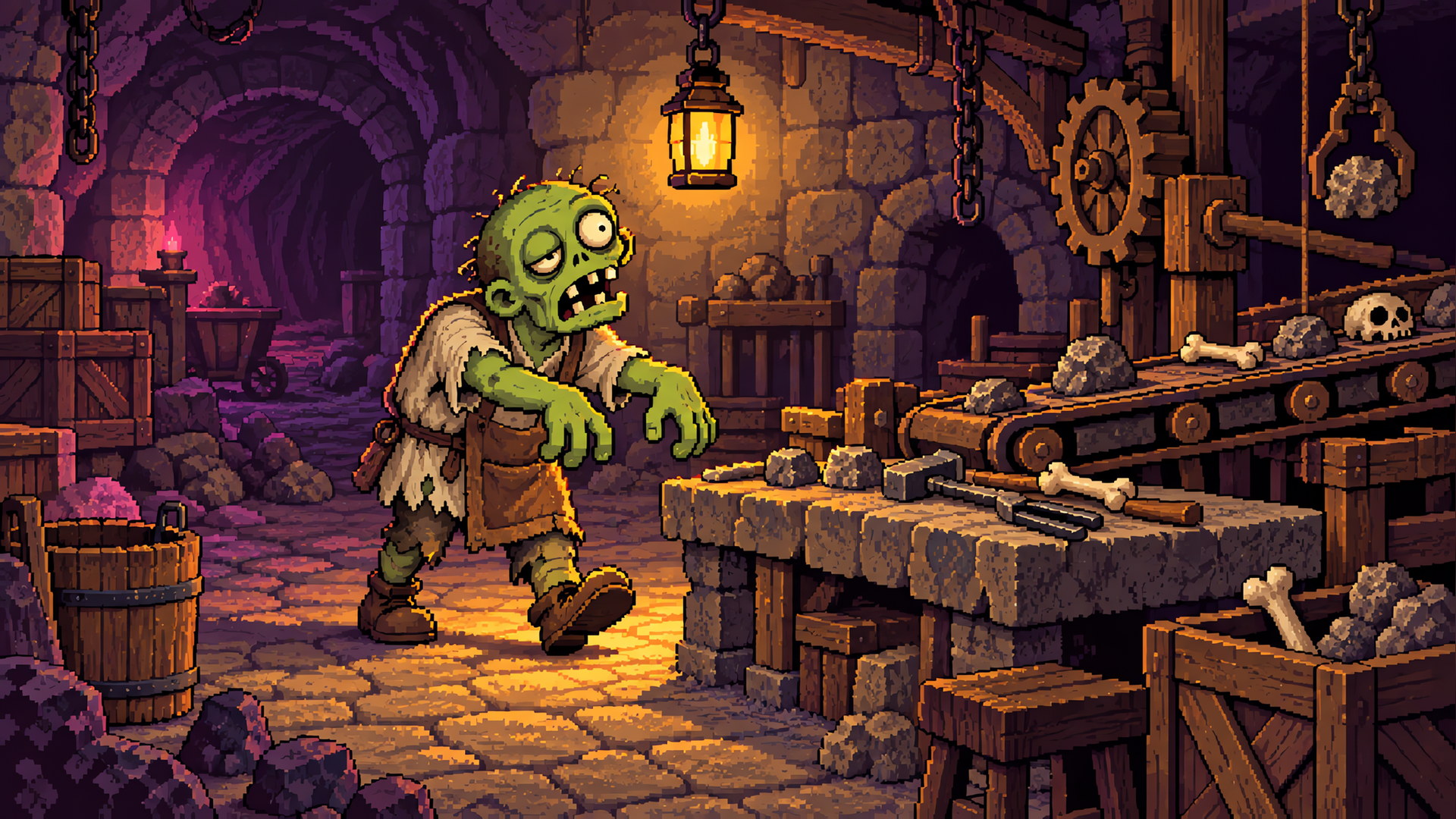
Zombies no longer only use regular workbenches. They can operate semi-automatic machines in underground factories, subject to meeting minimum working conditions. The constraint shifts from your own time to whether the station has inputs.
They cost nothing to keep
Your zombies do not ask for food or payment. Their cost is the setup: preparing a corpse correctly, and supplying the chain they sit on.
Corruption is now the good stat
The more corrupted a zombie is — the more red skulls it carries — the better the skills it can develop. That inverts the original game’s maths, where red skulls worked against a quality grave. The trade-off is deliberate: a clean corpse is a good burial, a corrupt one is a good worker.
Corruption can be added after death
If a corpse was not corrupt enough in life, the developer describes taking the most corrupted parts from other corpses and adding corruption embalming on top. That makes corruption a resource you assemble rather than one you simply find.
Zombies have their own progression
Each zombie levels separately, and the developer jokes that one may earn a name after ten years of loyal service. Where you route your best workers is the mid-game optimisation.
Two kinds of zombie
Yours are Possession-Free Zombies — made, in the developer’s words, with love and a pinch of science, mostly, each carrying a mark. The hostile ones occupying The Town are described as dark beings created from corrupted townsfolk through sinister curses, allegedly.