Alchemy in Graveyard Keeper 2

Alchemy is where the sequel turns herbs, organs and minerals into the fluids that raise a burial’s white skulls, the tonics that grow a zombie, and the knowledge that opens science gates. The station side is documented; the numbers behind it are community wiki data.

Facts checked September 18, 2026Reading time 8 min readEvidence cited per claim

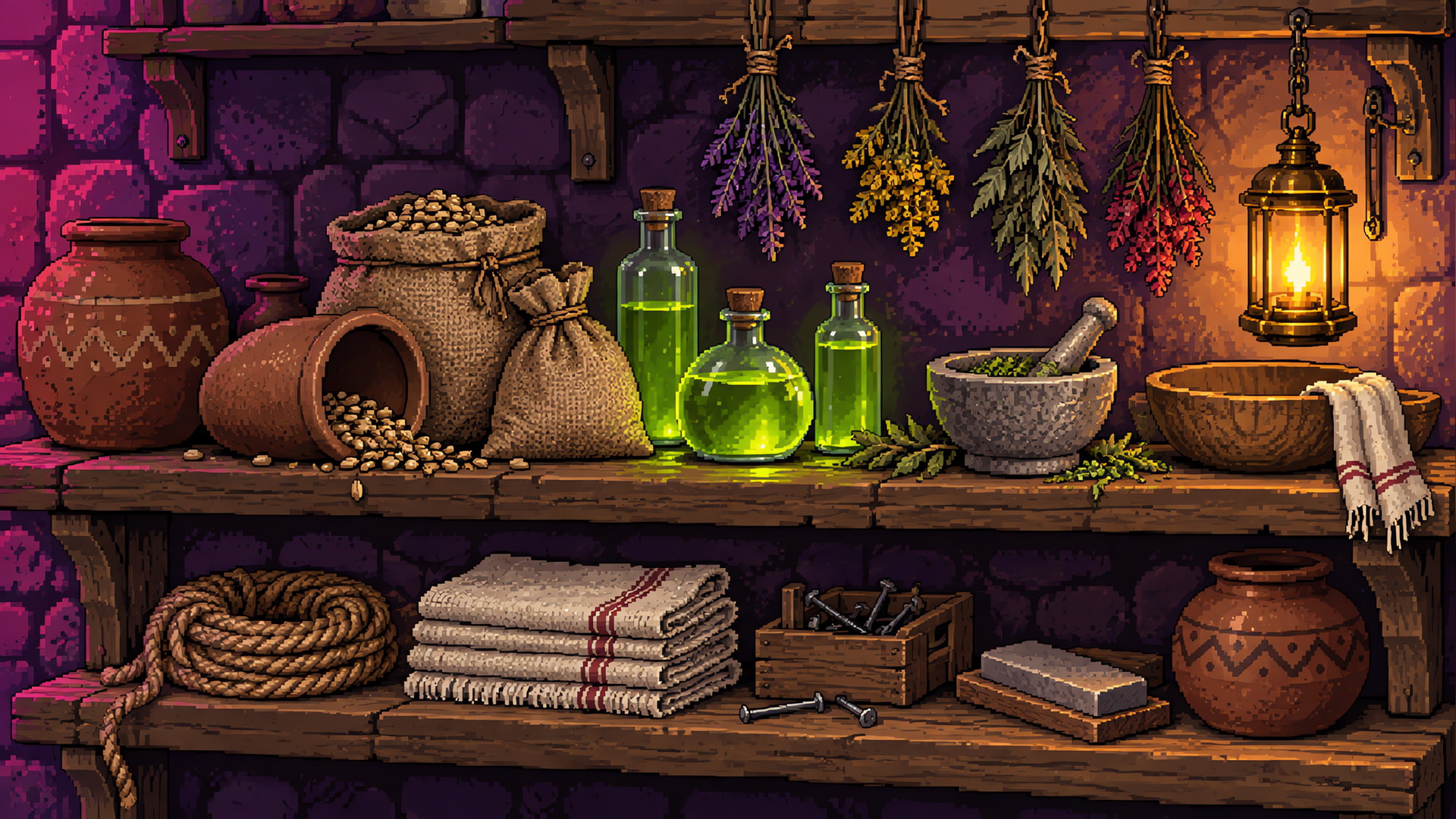
Illustration of a cluttered apothecary shelf: clay pots, seed sacks, glowing green potion bottles, a mortar and pestle, hanging dried herbs and a folded linen bundle.

What alchemy covers

Everything here is shape plus provenance: what the station is, what it eats, what gates it, and which of its numbers a player-written wiki published first.

Community wiki data

One table, three tiers

The alchemy table is the core station, and community material describes it as having three tiers. Each formula names a minimum station tier, and at least one of the four published formulas runs on a different station entirely — a Science-Enhanced Brewer.

Community wiki data

Three reagent pools

Ingredients arrive from three places: herbs grown in tilled plots, organs extracted through embalming or autopsy, and minerals that are mined or purchased. Those three pools are the reason alchemy sits between farming, the morgue and the mine rather than beside them.

Community wiki data

Science gates hold recipes back

Some recipes are described as activating only after a science gate has been unlocked, which gates progression behind experimentation rather than behind raw wealth. One of the four published formulas is a gate solvent that unlocks a single gate block.

Community wiki data

Bottled preservatives pay for themselves

Bottled preservatives are described as raising white skull ratings directly, which in turn raises burial income and reputation. That is the shortest line between the alchemy table and the graveyard it serves.

The core station

What the alchemy table actually does

Community material describes alchemy as a recipe-based crafting loop layered on top of the Technology Tree, with the table as the place where the raw inputs meet.

Community wiki data

It combines three kinds of raw input

Herbs harvested around the churchyard, organs salvaged from autopsied corpses and powdered minerals are combined at the table into reagents, potions and preservatives. The category covers every system, item and station that turns raw biological and mineral ingredients into bottled goods and unlockable knowledge.

Community wiki data

The output feeds several systems

Some of those fluids go back into burial work, while others restore health, cure afflictions or push open the science gates scattered across the map. That breadth is why the community page counts the alchemy table among a run’s first stations.

Community wiki data

Every formula declares its own requirements

A formula lists its required reagents, its minimum station tier and its result, and a result can be consumed, sold or used as an input to something else. Recipes are discovered rather than bought, which puts the study side of the game in the same chain.

The four published formulas

One community page publishes this reference table. It is the only formula list in the supplied material, and it is a fan page, so it is reproduced with its provenance rather than presented as the shipped recipe book.

RecipeReagentsEffect and station
Preservative FluidChamomile, Animal Fat, SaltRaises white skull quality on burial · Alchemy Table
Zombie TonicBone Marrow, Wormwood Extract, Mineral WaterBoosts zombie skill growth rate · Alchemy Table II
Embalming AcidFresh Heart, Sulfur Powder, Distilled VinegarStabilises corruption for named zombies · Science-Enhanced Brewer
Gate SolventSwamp Lily, Iron Filings, Crow GallbladderUnlocks a science gate block · Alchemy Table III

This table is community wiki data, unconfirmed as of September 26, 2026. It names ingredients, station tiers and a priority ranking that no developer or storefront source publishes, so treat the reagent names as the vocabulary to look for and the effects as the direction of travel — not as verified recipes. The same page ranks the four S, A, A and B without explaining what the ranking measures.

Beyond the bench

Brewing at scale, with zombies

The same community material describes what alchemy looks like once it stops being a hand-crafting chore.

Community wiki data

Underground factories can be staffed

Machine-assisted brewers in underground factories are described as staffable by zombies, which turns alchemy into semi-automatic production that scales with the corpse-based workforce. Forgetting to assign a zombie to a brewer is listed among the most common mistakes, because it leaves the whole line manual.

Community wiki data

Brewing speed follows the worker

A zombie’s brewing speed depends on its individual skill growth, which makes named zombies with relevant specialisations more valuable on a brewer than a generic body. That turns alchemy staffing into the same decision as every other zombie assignment.

Community wiki data

Quality and corruption change the result

Quality and corruption are described as influencing yields and rarities, so the table rewards planning rather than bulk input. Corruption-based modifiers can also produce unstable results, which costs extra inputs to retry.

Community wiki data

Reagents rot

Many reagents rot or spoil if they are not processed quickly, so a brewing queue without storage planning wastes organs and herbs that took real effort to gather. That is the argument for processing near the source rather than stockpiling.

A reported money method

The flask route, as one video describes it

A supplied one-minute video describes alchemy as a way to turn water into money. It is a single creator’s routine with no numbers attached, so it is recorded here as a report rather than as a route to follow blindly.

Supplied video

Glass first, then the flask

The reported order is to produce glass and then turn that glass into alchemy flasks. Nothing in the video says where the glass comes from, so the glass step is the part to work out from your own production chain.

Supplied video

Brew them at the laboratory station

The maker goes to the tower in the Alchemy lab and uses the laboratory station there, with water on both sides. The batch is crafted to the stack cap of 99, which the creator says took about two minutes and returned a noticeable amount of points as well as goods.

Supplied video

Sell the batch at the NPC trade

The creator teleports to the NPC trade and sells the batch, calling it the easiest money method they know. The transcript’s wording for the item being sold is garbled — it reads as a different word — so what exactly is sold back is unconfirmed.

Nothing in that video gives a sale price, a crafting cost or a profit figure, and no other supplied source mentions selling alchemical goods for money. The route is reported, not verified: unconfirmed as of September 26, 2026.

Mistakes the material names

Community material lists three habits that stall the alchemy chain, and all three are planning failures rather than farming failures.

Stockpiling one reagent type

Hoarding a single reagent looks like progress and is not, because every formula needs two or three inputs at once and several of them spoil. Balance beats volume.

Ignoring the Technology Tree prerequisites

Recipes sit behind technologies and science gates, so a full shelf of ingredients can still produce nothing. Checking the tree first is cheaper than gathering ingredients you cannot use yet.

Forgetting to staff the brewers

A factory brewer with no zombie assigned keeps producing nothing at all, and the failure is silent. The material treats this as the most common reason a mid-game alchemy line looks idle.

What is still unknown

Alchemy has a documented shape and almost no documented arithmetic. These are the questions the supplied material leaves open.

  • How many formulas exist. One community page publishes four and labels them a reference rather than a complete list — unconfirmed as of September 26, 2026.
  • What a formula costs to brew, and what the finished bottle sells for. No source gives either — unconfirmed as of September 26, 2026.
  • What the science gates are, how many there are, and where they sit on the map. The community page says multiple and names none.
  • What the priority ranking S/A/A/B on the published table actually measures.
  • Which reagents rot, how quickly, and whether storage or a station slows it down.
  • Whether quality and corruption change the quantity of a brew or only its rarity, and whether an unstable result can be prevented.
  • What a Science-Enhanced Brewer is, where it is built, and how it differs from the third table tier.
  • Whether the underground factory brewers are reachable before part of The Town has been restored.
  • What an alchemy flask is actually used for, beyond being sellable, and whether the stack cap of 99 applies to every alchemical output.

Where these facts come from

Every entry below is labelled by what it is: a developer or publisher source, a platform store listing, a press report, a video, or a fan-maintained page. Fan pages are used for terminology, and where one is the only record of a number, that number is written as community wiki data, unconfirmed, with the date it was last checked.

  • Fan page graveyard-keeper2-wiki.wiki — Alchemy — Player-written alchemy page captured 2026-09-26. Source of the alchemy table tiers, the four-formula reference table with its S/A/B ranking, the three reagent pools, science gates, zombie-staffed brewers, the spoilage warning and the common-mistakes list. It is the only formula list anywhere in the material, and every value from it is labelled "community wiki data, unconfirmed as of September 26, 2026" on /alchemy/.
  • Video Wasting — The Easiest Money Method You Missed (Graveyard Keeper 2) — A 1:18 creator video captured 2026-09-26 describing a post-launch money route: make glass, turn it into alchemy flasks at the laboratory station in the Alchemy lab tower, craft to the stack cap of 99, then sell at the NPC trade. It gives no price, cost or profit figure, and its wording for the item being sold is garbled, so the sold item is recorded as unconfirmed.
Questions

Alchemy questions

What is alchemy for in Graveyard Keeper 2?

It turns raw biological and mineral ingredients into bottled goods, embalming fluids and unlockable knowledge. Some of that output feeds burial work by raising white skull quality, some restores health or cures afflictions, and some opens the science gates that hold recipes back. Community material describes nearly every late-game chain as depending on a steady supply of it.

Do you need the alchemy table before you can embalm corpses?

Yes, according to the community FAQ in the supplied material: basic embalming fluids are the earliest recipes on the table, and without them burials are described as suffering from poor preservation, which lowers white skull quality and income. That is a fan-page claim rather than a developer statement.

Can zombies brew potions?

Community material says machine-assisted brewers in underground factories can be staffed by raised corpses once the relevant factory tier is unlocked, and that a zombie’s brewing speed depends on its individual skill growth. The same material lists forgetting to assign a zombie to a brewer as a common mistake, because the machine then does nothing.

What are the three reagent sources?

Herbs grown in tilled plots, organs extracted through embalming or autopsy, and minerals that are mined or purchased. Ingredients from all three appear across the four published formulas, which is why alchemy depends on the Garden, the morgue and the mine at the same time.

What are science gates?

Progression blockers that keep certain recipes inactive until they are unlocked. Community material describes them as gating progress behind experimentation rather than wealth, and lists a Gate Solvent made from swamp lily, iron filings and crow gallbladder as the formula that opens one gate block.

Is the glass-to-flask method a reliable way to make money?

Unconfirmed as of September 26, 2026. It comes from a single one-minute creator video that gives no price, no crafting cost and no profit figure, and that does not say where the glass comes from. No other supplied source mentions selling alchemical goods for money.

Are the recipes on this page confirmed?

No. The four formulas come from one player-written wiki and are community wiki data, unconfirmed as of September 26, 2026. No developer, publisher or storefront source publishes an alchemy recipe list, so the names here are the vocabulary to look for rather than verified recipes.