Rebuilding The Town in Graveyard Keeper 2

The Town was the sequel’s headline promise for a reason: in 2018 it was a locked, legendary place you never got to enter. It is playable now, largely abandoned and overrun, and restoring it turns out to be a graveyard upgrade as much as a building project.

Facts checked September 16, 2026Reading time 7 min readEvidence cited per claim

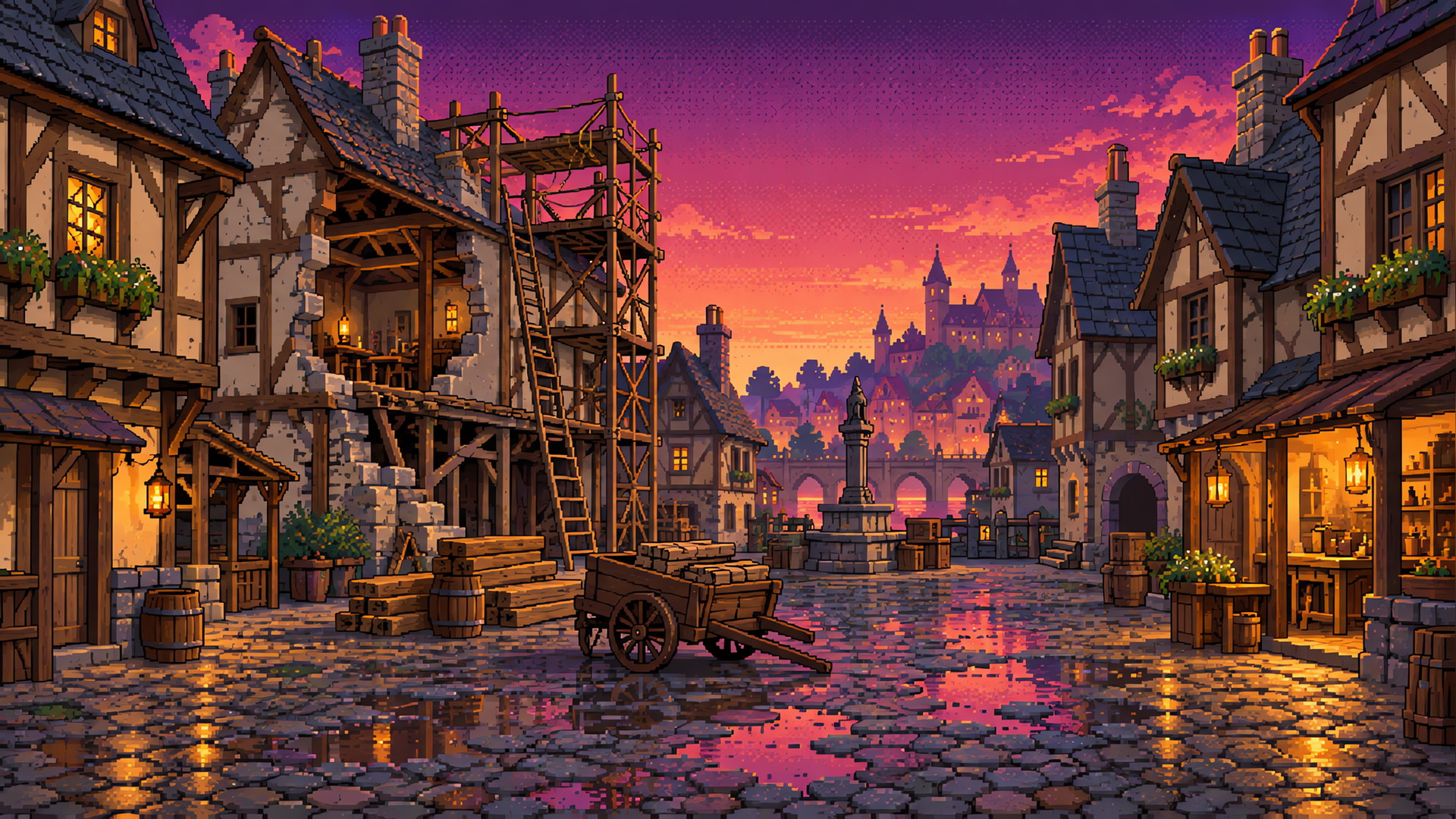
Illustration of a half-rebuilt medieval town square at dusk with scaffolding, lit shop windows and wet cobbles.

The restoration loop

Lazy Bear has described the Town in enough detail to state its shape precisely, even though no distance, cost or building list has been published.

Reclaim, then restore

The Town is recovered district by district. You take an area, then bring it back to life with comfortable housing, cafés and shops, and local infrastructure. Those three categories are the developer’s own wording and are the only building vocabulary that is attested.

Buildings create markets

Restored buildings create new markets for your goods and unlock valuable products and resources for you to buy. That closes the loop with the factory side: refined goods need somewhere to be sold, and the Town is that somewhere.

A bigger Town means more corpses

The larger The Town grows, the more corpses you receive. Population is throughput: a thriving Town is a supply line into your morgue.

A wealthier, more sinful Town means better corpses

The more prosperous and more sinful the Town becomes, the better those corpses are — each one carrying more skulls. This is the sentence that makes the whole sequel cohere, because skulls are simultaneously grave quality and zombie potential.

The real problem is not the zombies

The developer frames the Town’s actual difficulty as hopelessness and a lack of consumer goods. Once defences are in place, people can live alongside zombies fine — and zombies may even become a local tourist attraction.

It keeps running without you

Lazy Bear states that even long after the story ends, The Town will continue to exist and evolve on its own. The endgame is a system you leave running rather than a final state you reach.

Beyond the Town

The developer’s September 2026 story letter describes a wider world than the original had: the southern outskirts, another village and tavern, another forest and swamp, another church and graveyard. Traders from foreign lands and refugees looking for new homes are named as the people you meet there. Fast travel between unlocked points is handled by Milestones — the original’s teleportstones are gone.

In the world

Locations visible in official material

These are place names that appear on the game’s own screenshots and store material. They are recorded here for orientation, not as a map.

Graveyard
Your base and the game’s first stage — burials, harvesting and the earliest production.
Garden
Adjacent growing space with raised beds and a work counter. Harvesting is manual; farming is not pre-automated.
Town Workshop
An indoor hall that reads as a zombie factory floor.
Astrologer’s Tower
An interior with a ritual floor and celestial equipment — an NPC location rather than a production site.
Town — Port Area
A waterfront under construction, tied to later story traffic and to at least one recipe arriving by message.
The Swamp
Home of an alchemist, with clay deposits and alchemy reagents.

How to advance without wasting a week

These are planning rules drawn from the confirmed structure, plus the demo-observed campaign shape. The structure is developer-stated; the ordering is pre-release experience.

Finish the graveyard before chasing districts

The four stages run graveyard, automation, Town, army, and each produces the input the next consumes. A stalled Town is almost always an upstream graveyard problem.

Treat a restored district as a market decision

Buildings sell what your automated chains already make. Pick the next building by asking what you have surplus of, not what looks most finished.

Do not treat the Town as optional side content

It gates the vendors that make factory-scale production profitable. Without restored shops, refined goods have nowhere to go, and the automation investment stops paying.

Expect a preparation gate on the fighting

The demo-observed campaign puts a squad-control battle at the Town with a guard who wants your equipment count raised before the attack. The gate is real, and arriving under-prepared is the failure mode flagged in pre-release write-ups.

Still unknown

The developer has described the Town’s verbs in detail and its numbers not at all. These are open.

  • How many districts The Town contains.
  • The list of restorable buildings, and what each one unlocks specifically.
  • Restoration costs, material requirements and build times.
  • Whether district order is fixed or free.
  • How Town prosperity is measured, and how much of it you need before corpse quality visibly improves.

Where these facts come from

Graveyard Keeper 2 is not out yet, so nothing here is reproduced from a finished-game wiki. Each entry below is labelled by what it is: a developer or publisher source, a platform store listing, a press report, a video, or a fan-maintained page. Fan pages are used for terminology only, never for numbers.

  • Store listing Graveyard Keeper 2 on Steam (app 4358690)The most detailed platform listing: 11 interface languages, single-player only, full controller support with DualShock and DualSense entries, Steam Cloud, Achievements, Family Sharing, and the Windows minimum and recommended specifications.
  • Fan page gk2guide.wiki — Graveyard Keeper 2 Walkthrough: Progression OrderA pre-launch fan page that is explicit about the limits of what exists: it states there is no published step-by-step walkthrough and that any site claiming one before September 22 is guessing. Its four-stage framing (graveyard, automation, Town, army) is a reading of the developers’ own descriptions rather than datamined structure.
  • Fan page graveyard-keeper2-wiki.wiki — Guides indexFrames the sequel’s loops as corpses scored on both white skulls (quality) and red skulls (corruption), with Milestones replacing the original’s teleportstones and Talents softening repeat actions. Used for vocabulary.
  • Fan page dq7reimagined.com — Graveyard Keeper 2 Beginner GuideSource of the opening route described on the beginner page: escape the ruined Inquisitor district, collect the free sword and armour at the town defences, go west to the abandoned Inquisitor base, run the first autopsy, finish the grave and its sign, hand in the Burial Certificate, then push Graveyard Quality to 10. Written against the pre-release build.
Questions

The Town questions

Is The Town playable in Graveyard Keeper 2?

Yes. It is a playable location rather than the locked tease it was in the original. You reclaim it district by district and restore each area with housing, cafés, shops and local infrastructure.

Why should I rebuild The Town?

Three reasons the developer states directly: restored buildings create markets for your goods and unlock things to buy, a larger Town sends you more corpses, and a more prosperous and more sinful Town sends better corpses with more skulls. Town restoration is therefore also graveyard and workforce progression.

How many districts does The Town have?

Unconfirmed. No developer statement or storefront detail found names a district count, and no list of the districts exists in official material.

What buildings can I restore?

The only attested categories are comfortable housing, cafés and shops, and local infrastructure — the developer’s own wording. Specific building names and their individual unlocks are not published.

Do zombies and townspeople get along?

The developer’s framing is that once the Town has proper defences, people can live alongside zombies reasonably well, and zombies may even become a local tourist attraction. The stated obstacle is hopelessness and a shortage of consumer goods rather than the undead.

Is there fast travel?

Yes, via Milestones between unlocked points. The original game’s teleportstones have been replaced, so route planning around your Milestone coverage is a real consideration.